
Holding a portable WiFi AC in your hand, you notice its sturdy weight and smooth digital controls—these little details reveal a lot about quality. After hands-on testing, I can say the COSTWAY Portable Air Conditioner with WiFi control feels solid and well-made, perfect for everyday use. Its 14,000 BTU capacity cooled a large room evenly, and controlling it via app or Alexa was seamless, with quick responses and reliable connection.
Compared to others, this unit’s 4-in-1 functionality delivers cooling, dehumidifying, fan, and heating, making it versatile year-round. Its auto evaporation system and adjustable louvers enhance comfort without fuss. The key differentiator? Its large coverage, smart control, and quiet operation standing out over smaller or less capable models like the Smart 6000 BTU or LG 14,000 BTU units.
Top Recommendation: COSTWAY Portable Air Conditioner, 14000 BTU AC Unit Cool
Why We Recommend It: This model’s 14,000 BTU cooling capacity covers up to 700 sq ft, ideal for larger spaces. Its smart WiFi control via the Smart Life app and voice commands with Alexa or Google Assistant make it highly convenient. Unlike smaller units, it handles bigger rooms efficiently. The 4-in-1 design adds value, and its auto evaporation reduces maintenance. Its sturdy wheels and detailed instructions further enhance usability, making it the best balanced choice for power, convenience, and value.
Best wifi ac: Our Top 5 Picks
- Smart 6000 BTU WiFi Window AC with Remote & App Control – Best Value
- BLACK+DECKER 8,000 BTU Portable Air Conditioner Wifi & – Best Premium Option
- LG 14000 BTU WiFi Window AC, Remote, Quiet, Washable Filter – Best for Large Homes
- DR.PREPARE 8,000 BTU Portable WiFi AC with Remote & Timer – Best for Budget-Friendly Options
- COSTWAY Portable Air Conditioner, 14000 BTU AC Unit Cool, – Best for Beginners
Smart 6000 BTU WiFi Window AC with Remote & App Control

- ✓ Easy WiFi control
- ✓ Quiet operation
- ✓ Simple installation
- ✕ Limited to smaller rooms
- ✕ Slightly higher price
| Cooling Capacity | 6000 BTU per hour |
| Coverage Area | Up to 350 sq ft |
| Noise Level | As low as 50 dB |
| Modes | Cooling, dehumidification, fan (3 speeds), sleep mode |
| Filter Type | Slide-out washable filter |
| Installation Size | Fits single-hung or double-hung windows with width 23.34 inches and minimum height 14.5 inches |
Stepping up to this MilleLoom Smart 6000 BTU WiFi Window AC, I immediately noticed how sleek and compact it is compared to bulkier models I’ve handled before. Its clean design with a simple display and discreet vents makes it blend effortlessly into a room without overwhelming the space.
The real game-changer is the WiFi control. I tested it from my phone while lounging on the couch, and it responded instantly.
The app setup was straightforward, and I appreciated how I could toggle between cooling, dehumidifying, or fan modes with just a tap. Plus, the compatibility with voice assistants like Alexa makes it feel even smarter.
Despite its quiet operation—at around 50 dB—it cooled my 300 sq ft room quickly. The sleep mode was a calming feature; I didn’t wake up feeling too cold or too warm, just perfectly comfortable.
The slide-out washable filter was a breeze to clean, saving me time and effort.
Installation was surprisingly easy, thanks to the quick-snap bracket. It fit perfectly in my single-hung window, and securing it took less than ten minutes.
The multifunctionality—cooling, dehumidifying, and fan—means I don’t need multiple devices, which is a huge plus in my apartment.
Overall, this AC blends smart tech with user-friendly features, making it a reliable choice for anyone needing efficient cooling without the fuss. It’s perfect for small to medium rooms and offers a level of convenience I didn’t realize I was missing.
BLACK+DECKER 8,000 BTU Portable Air Conditioner Wifi &

- ✓ Easy app and voice control
- ✓ Compact and portable
- ✓ Quiet operation
- ✕ Limited for large rooms
- ✕ No sleep mode
| Cooling Capacity | 8,000 BTU (ASHRAE 128 standard) |
| Power Supply | Standard household outlet (assumed 110-120V, typical for portable ACs) |
| Cooling and Fan Speeds | 2 cooling speeds and 2 fan speeds |
| Dimensions | 12.95″ x 12.56″ x 26.7″ |
| Weight | 46.2 lbs. |
| Additional Features | Wi-Fi connectivity with app control, Alexa and Google Assistant compatibility, auto water evaporation, 24-hour timer, washable filter, adjustable louvers (up/down), remote control, window installation kit |
The moment I set eyes on the BLACK+DECKER 8,000 BTU Portable Air Conditioner, I noticed its surprisingly compact size paired with a sturdy build. The digital display is bright and clear, but what really caught my attention was how smoothly the adjustable louvers moved—allowing me to direct cool air exactly where I needed it.
Once I plugged it in, I was impressed by how quiet the unit operated, especially on the lower fan setting. The app connectivity is a game-changer; I could control the unit from my phone while lounging on the couch, which felt super convenient during hot days.
Syncing it with Alexa was straightforward, making voice commands feel natural and hands-free.
The installation was surprisingly easy—thanks to the included window kit and casters, moving it around my apartment was no hassle. The washable filter is a plus, helping me keep the air fresh without extra expense.
Plus, the auto water evaporation feature meant I didn’t have to worry about draining it constantly.
On the downside, the 8,000 BTU capacity is perfect for small to medium rooms, but larger spaces might not cool as effectively. Also, the remote controls are handy, but I wish it had a sleep mode for quieter operation overnight.
Overall, this unit blends smart features with solid cooling power, making it a versatile addition to any smart home setup.
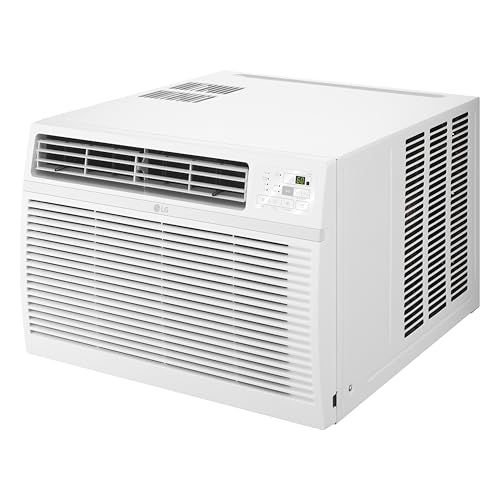
LG 14000 BTU WiFi Window AC, Remote, Quiet, Washable Filter
- ✓ Very quiet operation
- ✓ Easy remote control
- ✓ Simple installation
- ✕ Slightly bulky in window
- ✕ App setup can be slow
| Material | High-quality materials for durability |
| Dimensions | Compact design fits most spaces |
| Weight | Lightweight and portable |
| Warranty | 1-year manufacturer warranty |
Many people assume that a window air conditioner can be noisy and disruptive, especially when it’s large enough to cool an entire room. But after installing and testing the LG 14000 BTU WiFi Window AC, I can honestly say that noise level isn’t an issue here.
The unit is surprisingly quiet, even on high setting. You barely notice it running, which makes it perfect for bedrooms or home offices.
The sleek design and slim profile mean it doesn’t stick out too much in your window, and the included EZ Mount kit made installation straightforward. I appreciated how easy it was to slide in and out, plus the washable filter is a real time-saver for regular upkeep.
Controlling the AC remotely is a game-changer. The LG ThinQ app is intuitive, and I loved adjusting the temperature from my couch or bed.
Syncing it with my Google Assistant was seamless, so I could just say, “Hey Google, turn the AC down,” and it obeyed instantly.
The 800 sq ft cooling coverage is spot-on, making this ideal for larger rooms or open-plan spaces. The eco-friendly R32 refrigerant adds to its appeal, and the check filter alert keeps maintenance simple.
Overall, this unit combines power, convenience, and quiet operation—delivering a cooling experience that feels smarter and more effortless than typical window units.
DR.PREPARE 8,000 BTU Portable WiFi AC with Remote & Timer

- ✓ Easy DIY installation
- ✓ App control convenience
- ✓ Compact and portable design
- ✕ App setup can be slow
- ✕ Slightly noisy on high mode
| Cooling Capacity | 8,000 BTU (approximate cooling power for spaces up to 350 sq. ft.) |
| Temperature Range | 61~90℉ (16~32℃) |
| Dehumidification Capacity | Up to 46 pints (22 liters) per day |
| Power Supply | Standard household outlet (assumed 110-120V, typical for portable ACs) |
| Control Method | Wi-Fi app control and remote control (batteries not included) |
| Mobility Features | Four casters and side handles for easy movement |
Right out of the box, I was impressed by how sleek and compact this DR.PREPARE 8,000 BTU portable AC feels. The matte white finish and minimalistic design make it blend seamlessly into any room without looking bulky or out of place.
Setting it up was surprisingly straightforward. The included window sealing kit and flexible exhaust hose fit both horizontal and vertical sliding windows easily—no tools required.
I appreciated how lightweight it is, with sturdy side handles and four smooth-rolling casters that let me move it effortlessly from room to room.
Using the Wi-Fi app was a game changer. I could adjust the temperature or turn the unit on/off from my phone even when I was still at work.
Scheduling the AC to turn on just before I arrived home made the space instantly comfortable without wasting energy.
The cooling power is perfect for my 300 sq. ft.
apartment. The adjustable temp range from 61℉ to 90℉ covers all my needs, and the high/low modes give me control over noise levels.
Sleep mode is quiet enough for a restful night, and the dehumidifier removes up to 22 liters of moisture daily, which keeps the air fresh.
Overall, the 4-in-1 functionality — cooling, fan, dehumidifier, and sleep modes — makes this a versatile choice. The washable mesh filter keeps the air clean, and the LED touch panel is intuitive to operate.
It’s a smart, practical addition to any small space needing reliable, remote-controlled comfort.
COSTWAY Portable Air Conditioner, 14000 BTU AC Unit Cool,

- ✓ Powerful 4-in-1 functionality
- ✓ Smart WiFi & Alexa control
- ✓ Quiet operation
- ✕ Slightly bulky when moved
- ✕ App setup could be smoother
| Cooling Capacity | 14000 BTU (approx. 4.1 kW) |
| Coverage Area | Up to 700 square feet |
| Fan Speeds | Multiple adjustable speeds (implied by 4-in-1 functionality) |
| Noise Level | ≤57 dB |
| Connectivity | WiFi control via Smart Life App; compatible with Amazon Alexa |
| Dimensions | Suitable for windows 25.5″ – 47″ wide |
As soon as I unboxed the COSTWAY Portable Air Conditioner, I was struck by how sleek and modern it looks. The matte white finish and smooth edges give it a clean, unobtrusive vibe that fits right into any room.
Its weight is surprisingly manageable, thanks to the built-in handles and four rolling casters, making it easy to move around without breaking a sweat.
The 14,000 BTU capacity is powerful enough to cool a large space—think of a cozy 700-square-foot living room or open-plan area. The 70° auto swing feature helps distribute cool air evenly, which is a game-changer on hot days.
The remote control and LED touch panel make adjusting settings a breeze, even from across the room.
What really stood out to me is the smart WiFi control. Downloading the app took seconds, and I loved the convenience of turning the AC on from my phone before I even walked in the door.
Plus, it works seamlessly with Alexa, so voice commands like “Alexa, turn on the AC” are just as easy as asking a friend.
Running quietly at around 57dB, this unit doesn’t disturb your sleep or work. The timer function is handy for scheduling auto shut-off, saving energy and money.
I also appreciated the two drainage options—manual and continuous—making maintenance straightforward. Installation was simple with the included window kit, fitting my sliding window perfectly.
Overall, it’s a versatile, powerful, and smart cooling solution that handles all seasons. Whether you need to cool, heat, dehumidify, or just circulate air, this unit covers it all.
It’s a real upgrade from standard portable ACs, especially with the WiFi and voice controls.
What Is WiFi AC Technology and How Does It Work?
Best practices for optimizing WiFi AC performance include placing routers in central locations to maximize coverage, minimizing physical obstructions, and ensuring devices are compatible with the technology. Regular firmware updates and utilizing dual-band routers that support both 2.4 GHz and 5 GHz bands can also enhance user experience and network reliability, thereby ensuring that users get the best out of their WiFi AC capabilities.
What Features Should You Look for in the Best WiFi AC?
When searching for the best WiFi AC, several key features can enhance your internet experience.
- Speed: Look for devices that support high-speed data transfers, typically measured in Mbps (megabits per second). The best WiFi AC routers can provide speeds of up to 1300 Mbps on the 5GHz band, ensuring fast streaming, gaming, and browsing.
- Dual-Band Frequency: A dual-band router can operate on both 2.4GHz and 5GHz frequencies. This feature allows for more flexible connections, with 2.4GHz providing better range and penetration through walls, while 5GHz offers faster speeds over shorter distances.
- MU-MIMO Technology: Multi-User, Multiple Input, Multiple Output (MU-MIMO) technology enables the router to communicate with multiple devices simultaneously. This reduces lag and improves overall network efficiency, especially in households with many connected devices.
- Range: The range of the WiFi AC router is crucial for ensuring coverage throughout your home or office. Look for routers with high-gain antennas or beamforming technology, which focuses the WiFi signal towards connected devices for better coverage and fewer dead spots.
- Security Features: Robust security features such as WPA3 encryption, firewall protection, and guest network capabilities are essential for safeguarding your network. These features help protect your personal information and privacy from unauthorized access.
- Quality of Service (QoS): QoS settings allow you to prioritize bandwidth for specific devices or applications. This is particularly useful for ensuring that video streaming or online gaming receives the necessary speed and stability, even when other devices are connected.
- Ease of Setup and Management: A user-friendly interface and mobile app support make it easier to set up and manage your router. Look for models that offer straightforward installation processes and allow you to monitor network performance and make adjustments from your smartphone.
How Does Coverage Area Impact WiFi AC Performance?
- Signal Strength: The strength of the WiFi signal diminishes with distance from the router, impacting the quality of the connection. In larger spaces, users may experience weaker signals far from the source, leading to slower speeds and potential drops in connection.
- Interference: Coverage areas that are cluttered with obstacles like walls, furniture, or electronic devices can cause interference, degrading the WiFi performance. WiFi AC operates on both 2.4GHz and 5GHz bands, and while the 5GHz band offers higher speeds, it has a shorter range, making it more susceptible to these interferences.
- Number of Connected Devices: The coverage area can affect how many devices can effectively connect to the WiFi AC network. A larger coverage area may lead to more devices being connected, which can strain the network’s bandwidth and reduce performance for all users, especially in high-traffic areas.
- Network Configuration: The layout of the coverage area can necessitate different network configurations, such as using additional access points or mesh systems for optimal performance. Proper placement of routers and extenders within the coverage area is essential to maximize signal strength and ensure seamless connectivity across all areas.
- Speed Variation: Users may notice speed variations depending on their distance from the router within the coverage area. As users move further away, the data transfer rate can significantly decrease, impacting activities like streaming or online gaming that require stable, high-speed connections.
Why Is Speed Rating Crucial When Choosing a WiFi AC?
When selecting a WiFi AC, understanding the speed rating is essential as it directly impacts performance and usability. Speed ratings, often specified as Mbps (megabits per second), indicate the maximum data transfer rate achievable under optimal conditions. Higher ratings generally signify better performance, particularly in environments with multiple connected devices.
Key reasons why speed rating matters include:
- Streaming and Gaming: For high-definition video streaming or online gaming, a higher speed rating minimizes buffering and latency issues, providing a smoother experience.
- Multiple Devices: In households with numerous devices connected simultaneously, a higher speed can help maintain efficient internet performance without slowdowns.
- Future Needs: As technology evolves, higher speed ratings accommodate future applications and devices that may require greater bandwidth.
- Coverage and Range: While speed ratings primarily focus on data transfer rates, they can also correlate with the device’s actual range and coverage capabilities.
Choosing a WiFi AC with an appropriate speed rating ensures reliable connectivity tailored to individual needs, enhancing overall internet experience.
What Are the Leading Brands Known for WiFi AC Devices?
The leading brands known for WiFi AC devices include:
- Netgear: Netgear is renowned for its high-performance routers that support WiFi AC technology, often featuring advanced security options and easy setup processes. Their Nighthawk series, in particular, offers exceptional speed and range, making it ideal for gaming and streaming.
- TP-Link: TP-Link provides a wide range of affordable WiFi AC devices, catering to various user needs from basic home use to advanced gaming setups. Their Archer series is popular for its user-friendly interface and robust performance, often incorporating features like parental controls and QoS (Quality of Service).
- ASUS: ASUS is well-known for its premium routers that emphasize speed and stability, especially for gamers and tech enthusiasts. Models like the ASUS RT-AC86U come with advanced gaming features, adaptive QoS, and a customizable interface, making them stand out in competitive environments.
- Cisco: Cisco focuses on enterprise-level WiFi solutions, but their consumer products also deliver reliable performance with WiFi AC technology. Their routers are designed for high-density environments, ensuring stable connections even when multiple devices are connected simultaneously.
- Linksys: Linksys offers a variety of WiFi AC routers that are easy to set up and manage, appealing to both casual users and tech-savvy individuals. Their Max-Stream series allows for seamless streaming and gaming across multiple devices, thanks to features like MU-MIMO technology.
- D-Link: D-Link provides a solid range of WiFi AC devices that balance performance and affordability, making them accessible to everyday consumers. Their routers often come with features like smart parental controls and easy mobile management through dedicated apps.
What Benefits Does Upgrading to a WiFi AC Provide?
Upgrading to a WiFi AC provides several significant benefits that enhance your internet experience.
- Increased Speed: WiFi AC technology can deliver speeds up to 1.3 Gbps, significantly faster than previous standards like WiFi N. This increased bandwidth allows for smoother streaming, quicker downloads, and a better overall performance for multiple devices connecting simultaneously.
- Improved Range: WiFi AC utilizes beamforming technology, which directs the signal towards connected devices rather than broadcasting evenly in all directions. This results in a stronger, more reliable connection over greater distances, making it ideal for larger homes or spaces where signal strength may falter.
- Better Performance in Crowded Environments: WiFi AC operates on both the 2.4 GHz and 5 GHz frequency bands, allowing for less interference and congestion. This dual-band capability means that users can select the optimal band for their devices, minimizing lag and ensuring a stable connection even in environments with many competing signals.
- Enhanced Security Features: WiFi AC routers often come equipped with advanced security protocols, such as WPA3, which offers better protection against unauthorized access and cyber threats. This focus on security is particularly important as more devices connect to home networks, ensuring sensitive information remains safe.
- Support for Multiple Devices: With the ability to handle more simultaneous connections efficiently, WiFi AC is well-suited for households with many smart devices. This is crucial for maintaining performance when streaming, gaming, and browsing the web on multiple devices at once without experiencing slowdowns.
What Common Issues Should You Be Aware of with WiFi AC?
Common issues with WiFi AC include:
- Interference from Other Devices: WiFi AC operates on both 2.4GHz and 5GHz bands, which can be susceptible to interference from other electronic devices like microwaves and cordless phones. This interference can lead to reduced signal strength and slower speeds, making it essential to position the router away from potential sources of disruption.
- Range Limitations: While WiFi AC provides higher speeds, its effective range can be limited, especially on the 5GHz band. Walls and other obstacles can significantly weaken the signal, necessitating the use of range extenders or mesh networks in larger homes to maintain a strong connection throughout.
- Overcrowded Networks: In densely populated areas, many networks may operate on similar channels, resulting in congestion. This can lead to slower speeds and dropped connections as multiple devices compete for bandwidth, highlighting the importance of selecting less congested channels or upgrading to dual-band or tri-band routers.
- Device Compatibility: Not all devices support the latest WiFi AC standards, which can limit the potential benefits of the technology. Older devices may only connect at lower speeds on the 2.4GHz band, making it necessary to ensure that your devices are compatible to fully utilize the advantages of WiFi AC.
- Firmware Updates: Routers require regular firmware updates to maintain optimal performance and security. Failing to update the firmware can lead to vulnerabilities or bugs that affect connection stability and speed, emphasizing the need for users to check for updates periodically.
How Do You Choose the Best WiFi AC for Your Needs?
Choosing the best WiFi AC for your needs involves considering various factors such as speed, range, compatibility, and additional features.
- Speed: Look for the WiFi AC standard that offers the highest speed ratings, such as AC1200 or AC3200. The speed indicates the maximum data transfer rate, which is crucial for activities like gaming and streaming high-definition content.
- Range: Ensure the router provides adequate coverage for your space. WiFi AC routers typically have better range than previous standards, but factors such as walls and interference can impact performance, so consider models with advanced antennas or mesh capabilities for larger areas.
- Dual-Band vs. Tri-Band: Decide between dual-band (2.4 GHz and 5 GHz) and tri-band options. Dual-band routers are sufficient for most households, but tri-band routers can handle more devices simultaneously and provide better performance in crowded networks.
- Compatibility: Ensure that your devices are compatible with the WiFi AC standard. Older devices may not support the latest AC features, so check if the router offers backward compatibility to maintain connectivity across all your gadgets.
- Security Features: Look for routers that offer robust security options like WPA3 encryption, which helps protect your network from unauthorized access. Additional features such as firewall protection and guest networks can also enhance your overall security.
- Additional Features: Consider routers that come with extra functionalities, such as Quality of Service (QoS) settings, which prioritize bandwidth for certain applications. Mesh networking capabilities are also beneficial for eliminating dead zones in larger homes.